Why Key Largo Is Making Some Of Its Deepest Canals Shallower
August 13, 2026
August 13, 2026
The dock at the Rock Harbor listing measured out at thirty-five feet. The seller's captain had rattled it off like a headline number, the kind of depth that lets a sportfisherman idle straight out without checking a tide chart. To a buyer shopping for boat access, it sounded like the whole reason to write an offer.
It is also, on paper, the exact reason Monroe County flags a canal for restoration.
One consideration when touring a Key Largo canal home is that in the county's own water quality program, a canal cut too deep decades ago can be selected for restoration. Depth is one of the criteria the county uses to rank canals for backfilling, and several Key Largo waterways have already had tens of thousands of cubic yards of fill trucked in to shrink them down to a target depth of about seven feet.
If you are comparing canal-front homes in Key Largo on the assumption that today's depth reading is a permanent asset, you are pricing the property against a number the county may be actively planning to change.
Most of the Keys' 502 residential canals were dredged decades ago, often to 20 to 25 feet, because deeper dredging produced more fill material to build up the surrounding lots. Nobody at the time was optimizing for water quality. The result is a network of long, dead-end canals that trap organic material, seagrass wrack, and stormwater runoff at depths tidal flow can never reach.
That trapped material decays, pulls oxygen out of the water column, and in the worst cases produces the sulfur smell residents in restored neighborhoods describe as a thing of the past. Monroe County's fix is counterintuitive if you are thinking like a boater: backfill the deepest sections until the canal bottom sits around seven feet, the depth marine scientists working with the county have identified as optimal for tidal flushing.
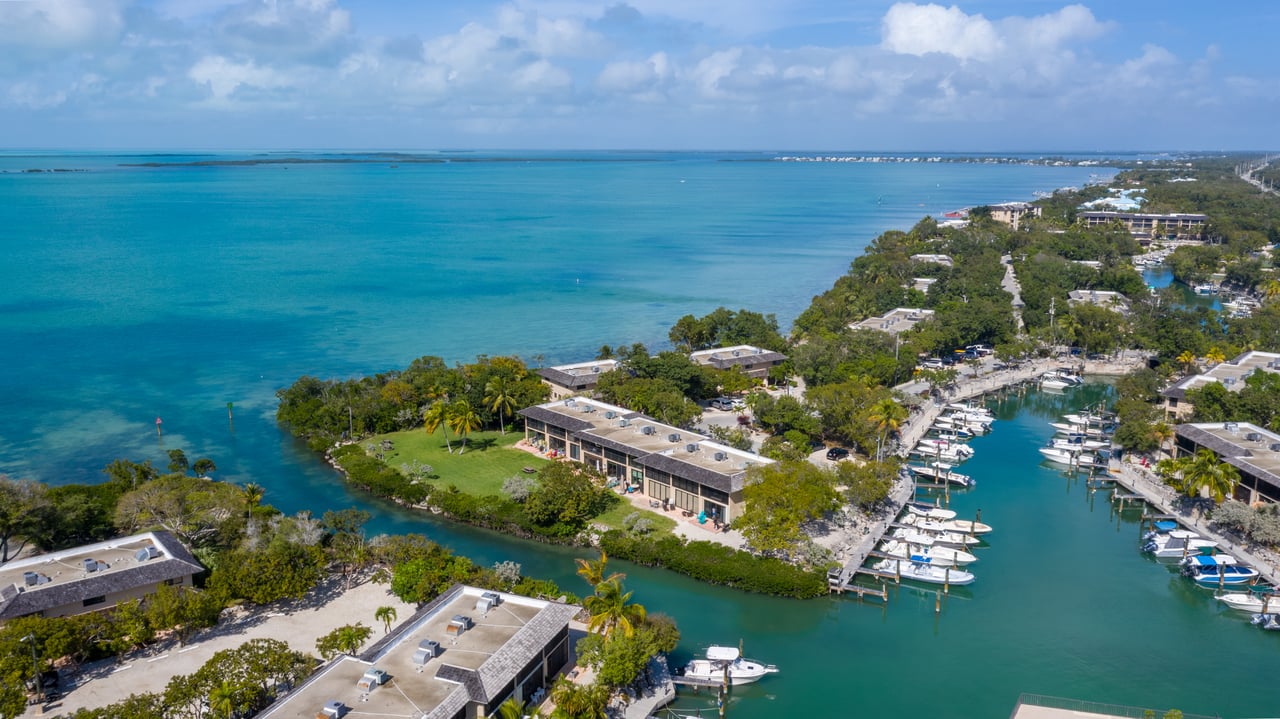
The county has already run this exact playbook in Key Largo. Canal No. 25 and Canal No. 28, both between Sexton Cove and Pigeon drives, were measured at roughly 40 feet and 35 feet before restoration. Canal 28 alone received about 36,530 cubic yards of backfill across 1,827 truckloads to bring it up to the 7-foot target. In Rock Harbor, Canal No. 84 went through the same process, with crews removing decaying vegetation before backfilling the deeper stretches to even out the bottom. Canal No. 90, between Hilson and Ivanhoe courts, followed the identical sequence, and Monroe County Mayor Holly Merrill Raschein visited the site while backfilling was underway.
Chief Resilience Officer Rhonda Haag, who has run the program for years, put the goal plainly after that visit: the improvements are meant to bring dissolved oxygen levels back up to state standards and increase marine life in the canal. For buyers, boat draft is a separate consideration.
Here is where the story gets less intuitive. You would assume the county fixes its worst canals first. Sometimes it does the opposite.
When Monroe County updated its selection criteria, three of the first five canals slated for work were rated "fair," not "poor." A senior engineering consultant on the project, Richard Fraxedas of the firm Wood, explained the reasoning to Keys Weekly:
"If you look at four half-million dollar projects that might combine to spread the positive impact throughout a larger area, you could have 2 million dollars' worth of expenditure that would far outweigh the benefit of a single $7 million project."
Translated for a buyer: the county isn't ranking canals by how bad they look. It is ranking them by cost per unit of improvement, and depth itself is one of the environmental factors that can push a canal up the list even if its water quality score isn't the worst on paper. A canal home marketed as having exceptional depth may be sitting on exactly the metric that gets it prioritized.
As of the county's 2022 annual report, the revised work program had identified 195 canals countywide needing restoration, with 15 completed and 13 underway. This is not a slow-moving study. It is an active construction schedule.
Canal | Location | Reported condition before work | What happened |
|---|---|---|---|
No. 25 | Near Sexton Cove / Pigeon drives | Roughly 40 feet deep, too deep for oxygen to reach the bottom | Backfilled to a 7-foot target |
No. 28 | Between Sexton Cove and Pigeon drives | Roughly 35 feet deep | Backfilled with about 36,530 cubic yards of fill |
No. 84 | Rock Harbor | Poor water quality rating, sections "too deep" per county reports | Organic removal, then backfill to even out the bottom near 7 feet |
No. 90 | Between Hilson and Ivanhoe courts | Targeted for the same restoration technique | Backfilled to roughly 7 feet, visited by the county mayor while work was underway |
Rock Harbor is a useful case study because the work there hasn't stopped. In May 2026, the county held a public meeting on the Rock Harbor Breakwater Repair project, a separate infrastructure effort in the same community that includes repairing the existing breakwater and installing a weed gate, with contractor Adventure Environmental Inc. and engineering firm WSP USA Inc. handling the construction, funded through a HUD grant routed via the state Department of Commerce. A canal that was backfilled years ago can still see follow-on construction in the same neighborhood as the county layers in additional water quality measures.
The program is also still funded. Florida lawmakers set the Florida Keys Stewardship Act appropriation at $20 million in the state's 2026 budget, and a March 2026 update confirmed canal restoration remains one of the county's most active resilience fronts, with a new backfill project in Key Largo planned alongside an ongoing jetty repair. The county is also re-ranking its canal list after an EPA grant changed how dissolved oxygen is measured, meaning the order in which specific canals get funded can shift year to year.
None of this means avoid canal-front property in Key Largo. It means treat the depth reading at a showing as a snapshot, not a guarantee, especially if the number sounds unusually deep for the area.
Before you weigh two canal homes against each other on boat access alone:
A canal reading forty feet today told you something true about the water on the day you measured it. It didn't tell you whether that canal is on a list that already backfilled its neighbors to a fraction of that depth.
Does a canal restoration project always mean less depth for boats? Not always. Some projects use culverts, weed gates, or air curtains rather than backfill, and those methods don't change the bottom depth. Backfill is specifically used on canals the county considers too deep for proper tidal flushing, generally anything well beyond the 7-foot target.
How do I find out if a specific canal is on the county's list? The Monroe County Canal Restoration page hosts a downloadable map you can search by address, which shows the canal number, current ranking, and depth data the county has on file.
Is this unique to Key Largo? No. The program covers canals across unincorporated Monroe County, and Marathon and Islamorada have run parallel restoration work on their own canal systems. Key Largo simply has several of the more visible, publicly documented projects, including Rock Harbor and the Sexton Cove corridor.
A canal home is still a lifestyle purchase built on real water, real docks, and real routes to the reef or the backcountry. But in Key Largo, the depth on the listing sheet is a data point with a shelf life, not a fixed asset. If you're weighing a canal-front property against the county's own restoration priorities, that's exactly the kind of local detail worth a conversation before you write an offer.
Kelsey Caputo-Frins works Key Largo's canal neighborhoods block by block, from Rock Harbor to Sexton Cove, and can help you check a specific canal's status before you compare it to anything else on the market. Reach out to request a valuation and design consult built around the water access you actually want to keep.
Stay up to date on the latest real estate trends.

Lifestyle
A Local Guide to the Best Pilates in Key Largo, Tavernier, Islamorada and Marathon—from Reformer and Mat Pilates to Private Sessions and Wellness Experiences Shaping t… Read more
Real Estate
Sales are up, prices are higher and nearly $2.2 billion in residential real estate has traded so far this year. Here’s what the data says—and what buyers and sellers s… Read more
Real Estate
Real Estate
A Local Buyer’s Guide to Key Largo, Tavernier, Islamorada, Marathon, Big Pine Key and the Lower Keys—Including Home Prices, Property Types, Insurance Considerations an… Read more