Tavernier Just Lost Its Under-the-House Inspection. Plantation Key Never Had One.
September 17, 2026
September 17, 2026
For seven months now, a Tavernier seller closing on a stilt home has been able to skip a step that used to sit on nearly every closing checklist in unincorporated Monroe County: a mandatory inspection of the space underneath the house before ownership could change hands. Monroe County eliminated that requirement, along with the decades-old 299-square-foot cap on downstairs storage enclosures, effective February 4, 2026. It is a real fix for a real problem.
It also does not touch Plantation Key at all, because Plantation Key has been part of the Village of Islamorada since 1997 and was never governed by the county rule the commission just repealed. Two addresses on the same stretch of the Overseas Highway, separated by Tavernier Creek, have been living under different sets of rules for over two decades. Most portal listings will not tell you which side of that creek your prospective home sits on. The building department will.
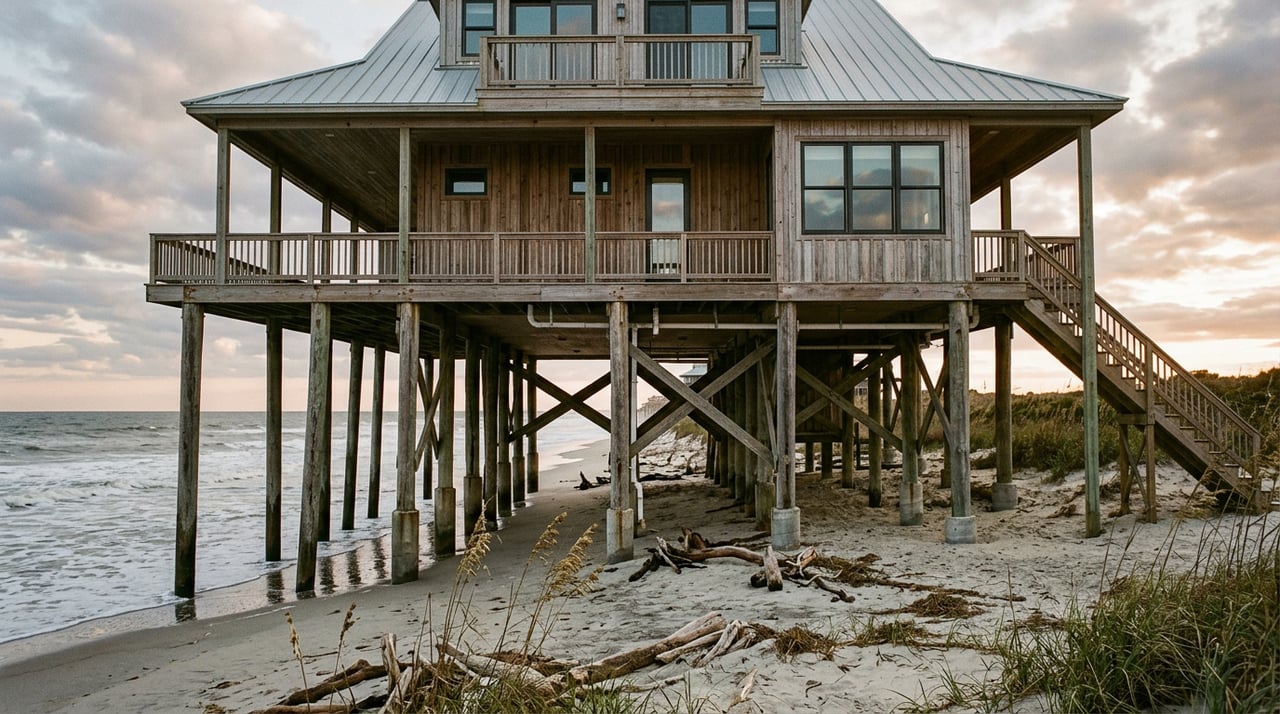
Elevated Keys homes almost always have an enclosed space underneath: a garage-like area used for parking, storage, or building access, sitting below the base flood elevation. Federal flood rules have never allowed that space to become living area, and for good reason. Monroe County was placed on probation by FEMA in 2002 for not enforcing that limit closely enough. To get off probation and stay eligible for the National Flood Insurance Program, the county agreed in 2004 to a remedial plan with two teeth in it: no downstairs enclosure in unincorporated Monroe County could exceed 299 square feet, and every one of those enclosures had to be inspected at the time of sale.
Neither rule was cosmetic. As of April 2025, Monroe County had roughly 11,110 NFIP-backed flood insurance policies on the books, which gives some sense of how many homes the remedial plan actually touched. If a downstairs enclosure had been quietly expanded past 299 square feet by a previous owner, or built without the right flood vents, the point-of-sale inspection was where that surfaced, often with the closing calendar already running.
By 2023, local real estate agents, contractors, and title company representatives had seen enough of it. They told county officials the rules were burdensome and were actively getting in the way of people trying to sell their homes, which set the current repeal in motion.
FEMA agreed in April 2025 to let Monroe County retire its 2002 remedial plan, and the county moved to formalize the change. As of February 4, 2026, the code amendments took effect: the 299-square-foot cap is gone, and so is the inspection required at time of sale.
Growth Management Director Emily Schemper described it plainly when the change was approved: "This is a major step forward for Monroe County residents." She added that removing the size restriction would give homeowners more flexibility while still keeping the county compliant with federal flood rules.
That last part matters, because nothing about habitability changed. A downstairs enclosure in unincorporated Monroe County still has to be used only for parking, storage, or building access. It still cannot be finished out as a bedroom, a den, or anything with air conditioning meant for daily living. And if an owner wants to permit a larger enclosure, the county still requires a recorded non-conversion agreement, a document that spells out exactly what the space can be used for so a future buyer inherits a clear record instead of a guess.
Here is the piece that a portal search will not surface. The 299-square-foot cap and the sale-time inspection only ever applied in unincorporated Monroe County. Every incorporated municipality in the Keys, including the Village of Islamorada, already allowed the full footprint under a home to be enclosed for storage. Plantation Key became part of Islamorada when the village incorporated on November 4, 1997. From that date forward, a stilt home on Plantation Key was governed by Islamorada's own building code, not the county floodplain rule tied to the 2002 FEMA probation.
Tavernier sits on the other side of Tavernier Creek, still unincorporated, still under direct county jurisdiction. That is the whole reason the February 2026 change is a headline for one half of this corridor and a non-event for the other.
| Tavernier (unincorporated) | Plantation Key (Village of Islamorada) | |
|---|---|---|
| Governing authority | Monroe County Building Department | Village of Islamorada |
| Old enclosure size limit | 299 sq ft, in effect until Feb 4, 2026 | Full footprint always allowed |
| Sale-time inspection | Required until Feb 4, 2026, now eliminated | Never required under this rule |
| Non-conversion agreement for larger enclosures | Still required | Governed by village code |
| Habitable space below flood elevation | Prohibited, unchanged | Prohibited, unchanged |
A buyer comparing a canal home near Hammer Point in Tavernier against one in Plantation Lake Estates on Plantation Key is comparing two different regulatory histories, even if both houses look nearly identical on stilts from the street.
If you are looking at an elevated home anywhere in this stretch, the first question is jurisdictional: is this address in unincorporated Monroe County or inside the Village of Islamorada? That single fact tells you whether the February 2026 change is relevant to the property at all.
If the home is on the Tavernier side, ask for the permit history on the downstairs enclosure. A seller no longer has to produce a sale-time inspection report, but that does not mean the enclosure's history disappears. If a previous owner ever pulled a permit to expand storage space, there should be a recorded non-conversion agreement tied to the property. Ask to see it. It tells you what the space is legally allowed to be used for, which protects you from inheriting an enforcement issue down the road.
If the home is on the Plantation Key side, the February 2026 change simply is not the relevant question. Ask instead about Islamorada's own permit and enclosure history for that address, since it was never part of the county's remedial plan to begin with.
Either way, none of this replaces a standard home inspection, a wind mitigation report, or an elevation certificate. It removes one specific piece of friction that used to complicate closings on one specific side of Tavernier Creek. Knowing which side you are on is most of the work.
Does this change apply to my home if I live in Islamorada? No. The 299-square-foot cap and the sale-time inspection only applied in unincorporated Monroe County. Homes within the Village of Islamorada, including all of Plantation Key, were governed by the village's own building code and were not subject to this specific county rule.
Can I now finish out my downstairs enclosure as living space? No. Removing the size cap did not change what the space can be used for. Federal floodplain rules still limit these enclosures to parking, storage, or building access. Converting one into habitable space remains prohibited regardless of size.
If I'm buying a Tavernier home, do I still need any kind of enclosure documentation? Yes. Ask for the permit history and, if the enclosure was ever expanded under a permit, the recorded non-conversion agreement. The sale-time inspection is gone, but the paper trail on legally permitted work still matters for your own protection.
Does eliminating the sale-time inspection mean I can skip a home inspection entirely? No. This rule change only removed a specific floodplain compliance inspection tied to the county's old remedial plan. A general home inspection, covering the structure, systems, and everything above and around the enclosure, is a separate and still worthwhile step in any purchase.
Buying or selling a stilt home in Tavernier or on Plantation Key involves exactly this kind of jurisdictional detail, and it rarely shows up on a listing sheet. If you want a clear read on what applies to your specific address, from the enclosure's permit history to what it means for your renovation plans, Kelsey Caputo-Frins can walk through it with you. Request a Valuation & Design Consult and get a straight answer before you write an offer or sign a listing agreement.
Stay up to date on the latest real estate trends.

Lifestyle
A Local Guide to the Best Pilates in Key Largo, Tavernier, Islamorada and Marathon—from Reformer and Mat Pilates to Private Sessions and Wellness Experiences Shaping t… Read more
Real Estate
Sales are up, prices are higher and nearly $2.2 billion in residential real estate has traded so far this year. Here’s what the data says—and what buyers and sellers s… Read more
Real Estate
Real Estate
A Local Buyer’s Guide to Key Largo, Tavernier, Islamorada, Marathon, Big Pine Key and the Lower Keys—Including Home Prices, Property Types, Insurance Considerations an… Read more